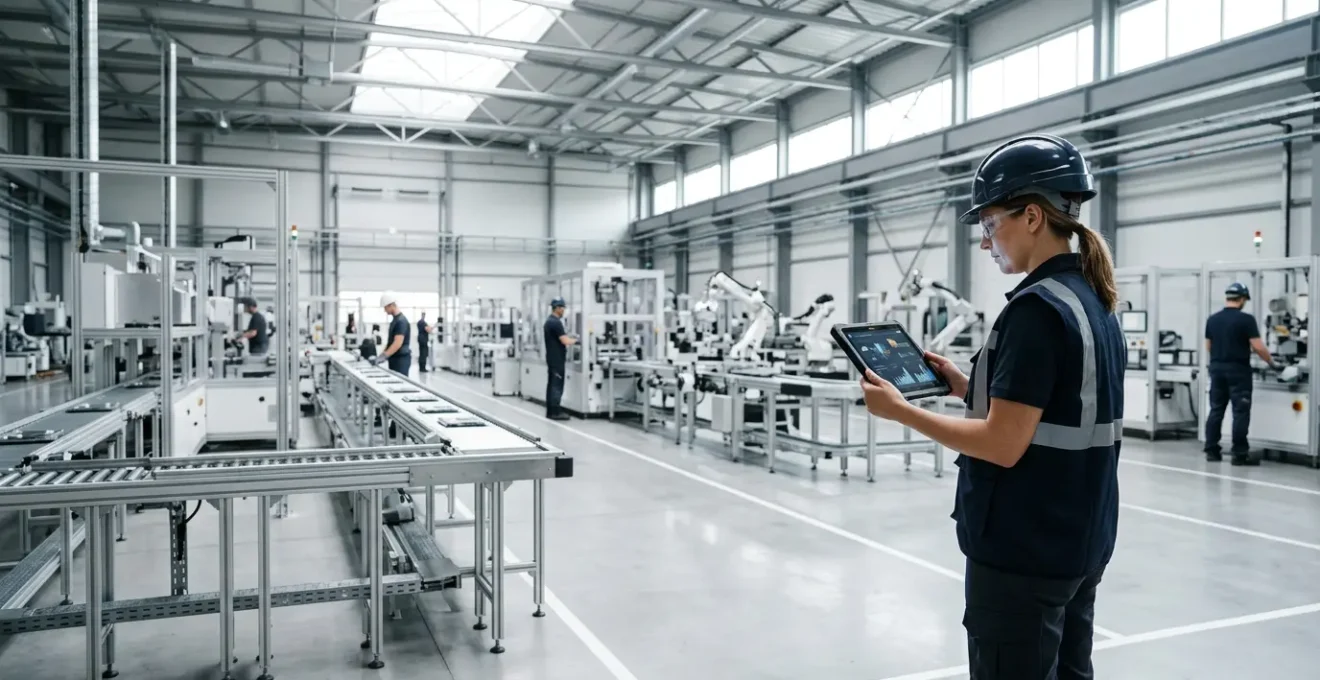
Contrary to popular belief, the biggest drain on manufacturing productivity isn’t just machine failure—it’s the ‘administrative waste’ that forces your most skilled engineers to perform low-value clerical work.
- This skill misallocation creates system friction, directly leading to costly production downtime and delays.
- Fragmented data across disconnected spreadsheets masks critical profit leaks and prevents effective decision-making on the factory floor.
Recommendation: The first step to reclaiming lost profit is to apply lean’s Value Stream Mapping to your administrative workflows, identifying and eliminating every non-essential task that diverts experts from their core functions.
As an operations manager, you live by the numbers. You see a high-value engineer—an expert in complex machinery and production flow—standing by a silent conveyor belt, filling out a supply requisition form on a clipboard. The cost of that idle machine is obvious. But the true, hidden cost is the catastrophic misallocation of resources: your most expensive problem-solver is tied up in low-value administrative work while output grinds to a halt. This is the heart of modern manufacturing inefficiency.
The conventional wisdom for tackling downtime focuses heavily on the machines themselves: predictive maintenance schedules, KPI dashboards, and operator training. While essential, these measures only address half of the problem. They ignore the silent productivity killer that happens away from the production line: the ‘administrative waste’ baked into your factory’s support processes. This includes everything from manual inventory ordering and complex shift handovers to fragmented payroll approvals and convoluted export documentation.
But what if the solution wasn’t another piece of software, but a fundamental shift in perspective? What if we applied the same rigorous lean manufacturing principles used to optimize the factory floor—like eliminating waste (Muda) and mapping the value stream—to the back office? The real key to unlocking the next level of factory output isn’t just about faster machines; it’s about freeing your most valuable human assets from the administrative burden that cripples their effectiveness.
This article provides a framework to do just that. We will dissect the most common administrative bottlenecks that cause costly downtime, from supply chain ordering to data management. By treating administrative tasks with the same analytical rigour as production processes, we will reveal how to systematically eliminate this waste, reclaim your engineers’ time, and directly boost your bottom line.
To navigate this analysis, we’ve structured this guide to address the most critical administrative bottlenecks one by one. The following sections provide a clear roadmap for transforming your support functions from a source of friction into a driver of efficiency.
Contents: Optimising Back-Office Processes to Eliminate Production Delays
- How to Automate Supply Chain Ordering When Factory Inventory Drops Below 15%?
- The Paperwork Bottleneck That Delays UK Export Shipments by 48 Hours
- When to Switch Shift Handovers From Physical Logs to Tablet-Based Dashboards?
- Why Burdening Floor Managers With Payroll Tasks Slashes Overall Production Yield?
- Dedicated Admin Staff vs Shop-Floor Self-Service Terminals: Which Works Best?
- Shortening the Production-to-Invoice Timeline to Retrieve Cash 14 Days Faster
- Why Running Your Factory on 15 Disconnected Spreadsheets Masks Critical Profit Leaks?
- Unifying Fragmented Manufacturing Data to Spot Margin Erosion Instantly on the Factory Floor
How to Automate Supply Chain Ordering When Factory Inventory Drops Below 15%?
Manual inventory management is a classic form of administrative waste. It forces floor managers or engineers to divert their attention from production to perform repetitive, low-value checks and data entry. This cognitive switching is not just inefficient; it’s a direct cause of downtime when a critical component runs out unexpectedly. The financial stakes are enormous, with some US facilities facing an average of 800 hours of equipment downtime annually costing over $50 billion. Waiting for inventory to drop to a static threshold like 15% is a reactive stance that guarantees periodic stock-outs and emergency orders.
The lean approach is to create a ‘pull’ system where the supply chain automatically responds to real-time consumption. This is achieved by implementing an automated ordering system based on dynamic reorder points, not arbitrary percentages. Such systems connect shop floor data directly with procurement, eliminating the need for human intervention in routine ordering. They analyze production capacity, demand models, and even real-time profit margins to trigger orders at the optimal moment, transforming inventory management from a clerical task into a strategic asset.
Case Study: Finsbury Food Group’s Inventory Optimisation
To combat administrative waste, Finsbury Food Group implemented a production scheduling optimisation system across all its sites. By automating sequence optimisation and factoring in capacity constraints and material requirements, the system enabled smarter procurement and optimised safety stocks. The result was a $2.1 million reduction in working capital, achieved by minimising setup times and maximising equipment utilisation without manual oversight.
Implementing this requires a shift from weekly or daily tracking to granular, hourly modeling. AI-powered planning software can then connect these strategic inventory goals with shop floor execution, setting up automated triggers based on dynamic reorder points. This proactive approach not only prevents stock-outs but also allows for ‘what-if’ scenario planning to buffer against supply disruptions or sudden demand changes, turning the supply chain into a resilient and efficient part of the production ecosystem.
The Paperwork Bottleneck That Delays UK Export Shipments by 48 Hours
In manufacturing, a bottleneck is any point in a process where the flow is restricted, causing delays and waste upstream. For many UK exporters, the single biggest bottleneck isn’t on the factory floor—it’s the mountain of paperwork required for international shipments. Manual creation, verification, and processing of customs declarations, certificates of origin, and packing lists create significant system friction. A single error or missing document can halt a multi-million-pound shipment for days, leading to missed deadlines, damaged client relationships, and substantial financial penalties. For many, these administrative delays are a primary reason why businesses lose up to 5% of overall revenue annually.
This administrative burden forces production staff to engage in activities far outside their core expertise, from chasing signatures to manually entering data into multiple carrier portals. The process is slow, prone to human error, and completely opaque, making it impossible to track progress or identify the source of delays. The solution is to treat documentation as a data flow, not a paper trail.

As this visualisation suggests, the transition from paper chaos to digital order is transformative. By implementing a unified digital manifest system, all documentation is generated, shared, and approved within a single platform. Data is entered once and automatically populates all required forms, drastically reducing the chance of errors. Customs brokers, freight forwarders, and clients can access real-time status updates, eliminating the need for constant phone calls and emails. This doesn’t just digitise the paperwork; it re-engineers the entire export workflow, removing the bottleneck and allowing your team to focus on what they do best: producing and shipping goods.
When to Switch Shift Handovers From Physical Logs to Tablet-Based Dashboards?
The shift handover is one of the most critical and vulnerable moments in a 24/7 manufacturing operation. A poor handover, based on incomplete or illegible notes in a physical logbook, can lead to incorrect machine settings, missed safety checks, or ignorance of a developing fault. This information gap is a direct cause of unplanned downtime. The switch to a tablet-based dashboard is not a question of ‘if’, but ‘when’ the cost of this administrative friction outweighs the perceived simplicity of paper. The tipping point arrives when handover errors start causing measurable production losses or safety incidents.
As an industrial efficiency expert, I see the physical log as a prime example of administrative waste. It’s a static, isolated data point that is difficult to access, impossible to analyse for trends, and highly susceptible to human error. A tablet-based dashboard transforms the handover into a dynamic, data-rich process. As one report notes, this shift in mindset is critical, since being proactive about maintenance and operations tasks can lead to a 65% reduction in unplanned downtime, a benefit directly enabled by better information flow.
The decision to switch can be clarified by comparing the two methods directly. The following table breaks down the operational differences, highlighting the clear advantages of a digital system for any modern factory.
| Aspect | Physical Logs | Tablet-Based Dashboards |
|---|---|---|
| Data Accessibility | Limited to on-site review | Remote access 30 minutes before shift |
| Error Rate | Higher due to manual entry | Reduced through automated data capture |
| Handover Time | 15-30 minutes average | 5-10 minutes with pre-review |
| Historical Data Analysis | Manual compilation required | Instant trend visualization |
| Implementation Cost | Low initial, high ongoing labor | Higher initial, reduced ongoing costs |
The ability for an incoming manager to review the dashboard 30 minutes before their shift starts is a game-changer. They arrive on the floor fully briefed, ready to direct their team, rather than spending the first critical minutes of their shift trying to decipher handwritten notes. This simple change alone drastically reduces the risk of handover-related downtime.
Why Burdening Floor Managers With Payroll Tasks Slashes Overall Production Yield?
A floor manager’s primary role is to manage the flow of production—optimising machine uptime, resolving bottlenecks, and ensuring quality control. Every minute they spend away from the shop floor dealing with administrative tasks like approving timesheets, handling payroll queries, or managing overtime requests is a minute of lost oversight. This is a critical form of skill misallocation. Burdening your most vital operational leaders with back-office work directly impacts production yield, because their focus is diverted from where it creates the most value. With machine downtime consuming up to 10% of factory production time, having your expert problem-solvers buried in paperwork is an unaffordable luxury.
The issue is compounded by the nature of payroll tasks. They are often complex, detail-oriented, and bound by strict deadlines, creating significant cognitive load for a manager whose mind should be on production variables. This forced context-switching between managing a high-speed production line and verifying an employee’s overtime hours is inefficient and a recipe for error in both domains. An error on the production line leads to scrap and downtime; an error in payroll leads to disgruntled employees and compliance issues.
The lean solution is to ruthlessly separate operational management from routine administration. This can be achieved through two primary routes. First, by implementing automated time and attendance systems that integrate directly with HR and finance, many approval processes can be handled by exception, freeing the manager from the day-to-day grind. Second, for more complex queries, a dedicated administrative support channel or self-service HR portal should be the first point of contact for employees. The floor manager’s role should be elevated to a final escalation point for operational issues, not a first-line clerk for payroll problems. By protecting your manager’s time and focus, you directly protect your production yield.
Dedicated Admin Staff vs Shop-Floor Self-Service Terminals: Which Works Best?
Once you’ve committed to removing the administrative burden from your production experts, the question becomes: how do you handle those tasks? The two primary models are hiring dedicated administrative staff or implementing shop-floor self-service terminals. The answer isn’t one or the other; the optimal solution, from a lean perspective, depends entirely on the nature of the task. A one-size-fits-all approach creates its own form of waste. The key is to match the solution to the task’s complexity and frequency.
For high-frequency, low-complexity tasks—like requesting Personal Protective Equipment (PPE), logging minor downtime events, or submitting a holiday request—a self-service terminal is vastly superior. These terminals, strategically placed on the factory floor, empower workers to handle simple requests instantly without leaving their work area or interrupting a manager. This eliminates the ‘waste of motion’ and ‘waste of waiting’ associated with finding a supervisor or walking to an office.

Conversely, for low-frequency, high-complexity tasks—such as resolving a complex payroll dispute, managing international logistics paperwork, or handling a sensitive HR issue—dedicated administrative staff are essential. These tasks require nuanced understanding, problem-solving skills, and often, confidentiality. Attempting to automate them through a terminal would lead to frustration and failure. The following matrix provides a clear framework for deciding which model to apply.
| Task Type | Frequency | Complexity | Recommended Solution |
|---|---|---|---|
| PPE Requests | High (Daily) | Low | Self-Service Terminal |
| Downtime Logging | High (Multiple daily) | Low | Self-Service Terminal |
| International Logistics | Low (Weekly) | High | Dedicated Admin Staff |
| Complex HR Issues | Low (Monthly) | High | Dedicated Admin Staff |
| Maintenance Requests | Medium (Several weekly) | Medium | Hybrid Approach |
By implementing a hybrid model guided by this logic, you create a highly efficient system that minimises administrative waste while ensuring that complex problems receive the expert attention they require. This frees up everyone—from operators to managers—to focus on value-adding production activities.
Shortening the Production-to-Invoice Timeline to Retrieve Cash 14 Days Faster
In lean manufacturing, the time it takes to convert raw materials into cash is a critical metric. A long production-to-invoice timeline is a form of ‘waiting’ waste that ties up working capital and harms cash flow. Often, the delay isn’t in production itself but in the administrative processes that follow. A finished product sitting in the loading bay waiting for paperwork to be processed before an invoice can be sent is just as costly as an idle machine. The goal is to create a seamless data flow where the moment of delivery automatically triggers the invoicing process, shortening the cash conversion cycle by days or even weeks.
The bottleneck is typically a reliance on manual batch processing. For example, a finance department that waits for a weekly report of all shipped goods before issuing invoices is introducing an artificial delay. This friction is often invisible because production and finance operate in separate data silos. However, simply visualising operational data on the shop floor has been shown to deliver a 10-15% increase in OEE (Overall Equipment Effectiveness); applying the same principle of real-time visibility to the financial workflow can yield similar gains in cash flow efficiency.
Accelerating the timeline requires applying Value Stream Mapping to the entire process, from the final quality check to the receipt of payment. The objective is to identify and eliminate every non-value-added delay. Key steps in this process include:
- Implementing automated Proof of Delivery (POD) systems that integrate directly with finance software.
- Triggering invoices instantly upon API confirmation of delivery from the carrier, rather than waiting for manual confirmation.
- Eliminating batch approval waiting periods by moving to real-time, exception-based processing.
- Establishing pre-emptive invoicing agreements with trusted, long-term clients to bill upon shipment rather than delivery.
By automating the hand-off between physical logistics and financial administration, you can retrieve cash significantly faster, improving liquidity and reducing the administrative burden on both your logistics and finance teams.
Why Running Your Factory on 15 Disconnected Spreadsheets Masks Critical Profit Leaks?
Running a modern factory on a patchwork of disconnected spreadsheets is like trying to navigate a ship in a storm with 15 different compasses. Each department—production, maintenance, quality control, logistics—has its own version of the truth. This creates information silos, the most insidious form of administrative waste. When data is fragmented, it’s impossible to see the bigger picture or understand the complex cause-and-effect relationships that govern factory performance. You are constantly reacting to problems rather than pre-empting them, and critical profit leaks remain hidden in the gaps between spreadsheets.
Case Study: The Disconnected Packaging Manufacturer
A packaging manufacturer struggled with downtime despite each department meticulously tracking its own performance in separate spreadsheets. By implementing a unified tracking system, they finally saw the whole picture. The data revealed that an upstream equipment failure was starving their primary bottleneck machine (the filler), while downstream blockages were preventing it from running at optimal speed. These critical profit leaks, which were the true source of their downtime, had been completely invisible when looking at departmental spreadsheets in isolation.
The core issue with disconnected data is the lack of a single source of truth. Time spent by managers and engineers trying to reconcile conflicting data from different spreadsheets is pure administrative waste. It leads to meetings where more time is spent arguing about whose numbers are correct than solving the actual problem. Furthermore, this fragmentation makes it impossible to perform meaningful root cause analysis. Is a drop in output due to a machine fault, a raw material issue, or a staffing shortage? Without unified data, the answer is just a guess.
This isn’t just a matter of inefficiency; it’s a matter of profitability and even safety. Fragmented data masks trends that could indicate a developing machine failure, leading not only to costly scrap and downtime but also potentially creating unsafe working conditions. The first step toward lean administration is to abandon the spreadsheet patchwork and commit to a unified data platform where all operational metrics are captured and displayed in real-time.
Key Takeaways
- The misallocation of skilled engineers to low-value clerical work, or ‘administrative waste’, is a primary and often-hidden cause of costly manufacturing downtime.
- Applying lean principles like Value Stream Mapping and waste elimination to back-office processes is as critical as applying them to the factory floor.
- A unified data system is non-negotiable. Fragmented data in disconnected spreadsheets makes it impossible to spot true root causes and critical profit leaks.
Unifying Fragmented Manufacturing Data to Spot Margin Erosion Instantly on the Factory Floor
Moving from a reactive to a proactive operational model is impossible without a single source of truth. Unifying fragmented data is the final and most crucial step in eliminating administrative waste. It transforms data from a historical record-keeping tool into a real-time strategic weapon. When operators, managers, and engineers are all looking at the same live data on Overall Equipment Effectiveness (OEE), downtime, and quality, the entire factory can respond to deviations instantly. This is essential, as a recent report revealed that for 29.4% of facilities, each unplanned downtime event costs more than it did in the past, making proactive control more critical than ever.
The goal of a unified system is to make margin erosion visible at the point of action—the factory floor. When a machine setting deviates from its optimal parameter, a real-time dashboard should immediately flag the potential impact on cost-per-unit. This empowers operators to make immediate corrections, rather than waiting for a quality report hours later after thousands of pounds in scrap have already been produced. This system connects every action on the floor directly to its financial consequence, embedding a culture of cost-consciousness throughout the entire team.

Implementing such a system requires a disciplined framework. It’s not about simply installing new software; it’s about changing how information is collected, categorised, and acted upon. The process starts with establishing a solid data baseline and moves toward collaborative, data-driven problem-solving directly on the shop floor. To begin this journey, you must first audit your current data landscape to identify all points of friction and fragmentation.
Your Action Plan: Auditing Your Factory’s Data Fragmentation
- Identify Data Entry Points: List every single channel where operational data is currently recorded (e.g., physical logs, individual spreadsheets, whiteboard notes, machine-specific terminals).
- Collect Data Samples: Inventory examples of existing reports from different departments (production, maintenance, quality) for a single production run.
- Assess for Consistency: Compare the data samples. Do they use the same definitions and categories for downtime? Do the numbers align or contradict each other?
- Analyse for Accessibility: Evaluate how quickly a floor manager can access and compare data from these different sources to make a real-time decision. Is it instant or does it require manual compilation?
- Draft an Integration Plan: Prioritise which disconnected data streams, if unified, would have the biggest immediate impact on identifying the root causes of downtime.
To transform these principles into profit, the next logical step is to conduct a Value Stream Map of your most critical administrative process. Start by identifying the single biggest source of administrative friction in your factory—be it procurement, shift handovers, or export documentation—and map every step to expose the hidden waste. This is the first action toward building a truly lean administrative backbone for your manufacturing operation.