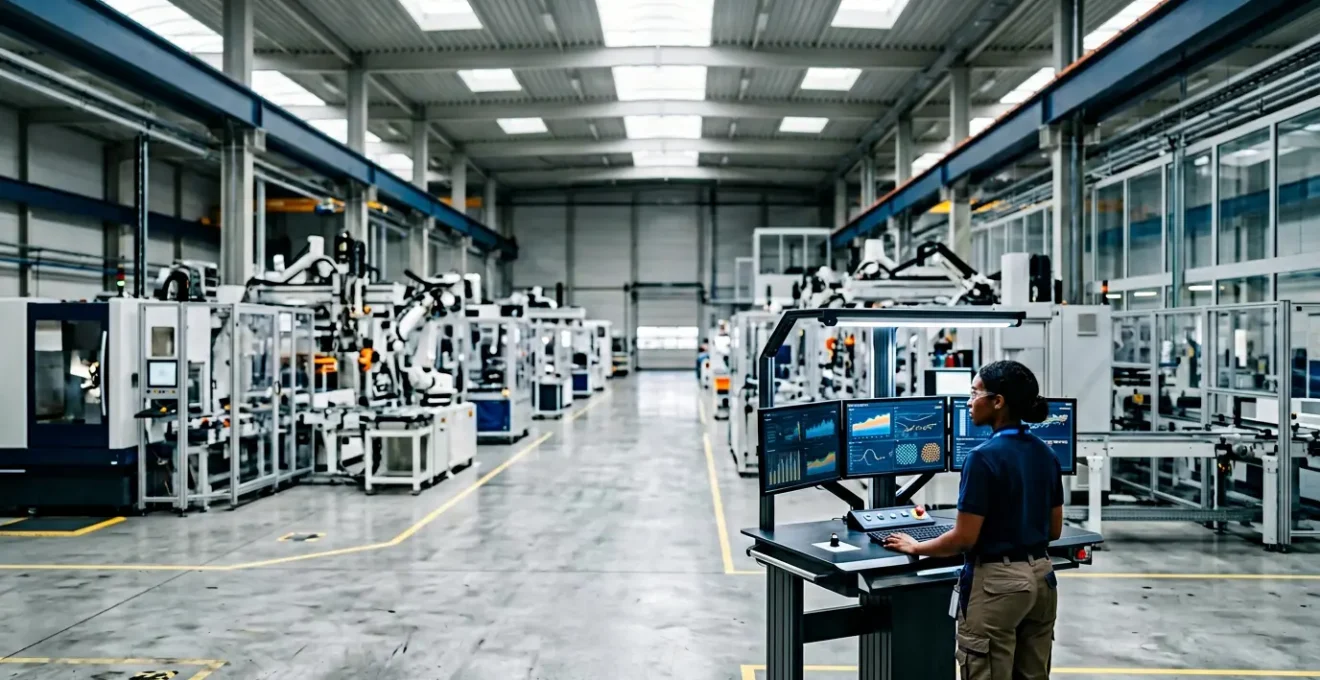
Your factory’s disconnected data is actively hiding profit leaks, turning a busy shop floor into a silent money pit.
- Spreadsheets and legacy systems create a false sense of control while masking critical errors and the high cost of data latency.
- A unified, industry-specific ERP provides the architectural backbone to link machine performance directly to financial outcomes in real time.
Recommendation: Stop chasing symptoms. The next step is to architect a single source of truth that translates operational events into immediate financial insights.
As a manufacturing CEO, you recognise the paradox: your order book is full, the machines are running, and your team is busy. Yet, every quarter, you’re confronted with mysteriously shrinking profit margins. You suspect the answer lies somewhere on the factory floor, but the data you receive is a tangled web of spreadsheets, legacy system reports, and manual logs. This fragmentation is the root cause, creating a blind spot where small inefficiencies compound into significant financial losses. While the common advice is to « break down silos » or « become data-driven, » these platitudes offer no practical blueprint for action.
The problem isn’t a lack of data; it’s the absence of a direct, real-time bridge between physical operations and financial reporting. You have operational data (uptime, scrap rate) and financial data (COGS, margin), but they exist in separate universes, reconciled only weeks or months after the fact. By then, the opportunity to intervene is long gone. The real solution lies in an architectural shift—designing a system that translates every event on the shop floor into an immediate financial metric on a dashboard.
This isn’t about buying more software; it’s about building a single source of truth. This article provides the blueprint for that architecture. We will deconstruct the hidden costs of fragmented data, guide you through the critical decisions in system unification, and demonstrate how to build a dashboard that doesn’t just report on the past but gives you the power to protect your margins in the present.
To navigate this complex but crucial transformation, this guide is structured to walk you through the strategic decisions required, from diagnosing the problem to implementing a future-proof solution.
Summary: The Blueprint for Real-Time Profitability
- Why Running Your Factory on 15 Disconnected Spreadsheets Masks Critical Profit Leaks?
- How to Transition from Legacy Software to a Cloud ERP Without Halting Production?
- Industry-Specific ERPs vs Generic Platforms: Which Manages Complex Bill of Materials Better?
- The Scope Creep Mistake That Turns a £50,000 ERP Implementation into a £200,000 Disaster
- Customising ERP Dashboards to Show Real-Time Profitability per Machine Operator
- When to Switch Shift Handovers From Physical Logs to Tablet-Based Dashboards?
- Shortening the Production-to-Invoice Timeline to Retrieve Cash 14 Days Faster
- Automating Administrative Workflows to Save 20 Hours a Week on Tedious Data Entry
Why Running Your Factory on 15 Disconnected Spreadsheets Masks Critical Profit Leaks?
The reliance on a patchwork of spreadsheets is the most common vulnerability in modern manufacturing. Each spreadsheet represents a data island—production schedules in one, inventory in another, quality control in a third. While they provide a semblance of control, they are fundamentally flawed. This disconnected ecosystem makes it impossible to see the cause-and-effect relationship between a production delay and its impact on per-unit profit. The data is static, backward-looking, and riddled with inconsistencies.
The financial risk is not theoretical. Studies consistently show the danger of basing critical decisions on this foundation. For example, research has found that 94% of business spreadsheets contain errors, ranging from simple typos to formula mistakes that can drastically skew financial projections. This isn’t just an IT problem; it’s a C-suite problem. When your cost-of-goods-sold calculation is based on a spreadsheet with a broken link, your entire profitability analysis is compromised. This is the definition of a hidden profit leak.
The core issue, however, often lies deeper than the technology itself. It’s about organisational habits that have been built around these fragmented tools. As one expert astutely notes, this challenge is often misdiagnosed. A leading manufacturing data specialist highlights the real issue:
What many manufacturers view as a ‘data problem’ is almost always a behavior, culture, and alignment problem.
– Erik (Manufacturing Data Expert), The ChangeOver Podcast – Data Unification for Manufacturers
Moving away from this model requires acknowledging that the « spreadsheet system » isn’t a system at all; it’s a collection of disparate data points that actively prevents you from seeing the true financial health of your operations in real time. It’s the primary barrier to establishing the Financial-Operational Bridge your business needs.
How to Transition from Legacy Software to a Cloud ERP Without Halting Production?
The decision to move away from legacy systems and spreadsheets is straightforward, but the fear of disrupting production can cause paralysis. The nightmare scenario of halting operations during a system migration is a primary reason many CEOs delay this essential upgrade. However, a well-architected transition is not a « big bang » event but a phased, controlled process designed to mitigate risk and ensure business continuity.
The most effective strategy is the parallel run approach. This involves running your new cloud ERP system simultaneously with your legacy systems for a defined period. This dual-system environment allows your team to learn the new platform, validate data integrity, and iron out workflows using live operational data, all without pulling the plug on the tools that currently run your business. It acts as a safety net, ensuring that if any issues arise in the new system, the old one is still operational.

This method provides a structured way to de-risk the entire project. You can compare outputs from both systems to ensure accuracy, from inventory counts to financial reports. It transforms the transition from a high-stakes gamble into a series of manageable, verifiable steps.
Case Study: Zero-Downtime Legacy ERP Migration
A financial and leasing provider faced the challenge of migrating two outdated legacy systems to a modern SAP ERP platform. By implementing a dual-system strategy, they ran the old and new platforms in parallel, allowing for methodical data validation and process refinement without disrupting daily business. The project was a success, leading to a 25% reduction in data volumes, a one-third increase in processing speed, and a remarkable 42% cut in annual operating costs, all achieved with minimal business interruption.
While industry data indicates that a full ERP implementation can take from six months to two years, the parallel run methodology ensures that your factory remains productive throughout this period. It’s a strategic investment in a seamless transition, not a costly operational shutdown.
Industry-Specific ERPs vs Generic Platforms: Which Manages Complex Bill of Materials Better?
Once the decision to migrate is made, the next critical choice is the platform itself. The market is flooded with ERP solutions, broadly divided into two categories: generic, « one-size-fits-all » platforms and industry-specific systems designed explicitly for manufacturing. For a CEO focused on margin erosion, this choice is paramount. A generic ERP may seem flexible, but it often requires extensive and costly customisation to handle the unique complexities of a factory floor.
The most significant of these complexities is the Bill of Materials (BOM). In manufacturing, a BOM is not just a simple list of parts; it’s a dynamic, multi-level structure that includes sub-assemblies, labour costs, machine time, and overheads. Generic ERPs struggle to model this accurately out of the box. Attempting to force a generic system to conform can lead to massive budget overruns; industry statistics reveal that ERP customisation projects have an 189% average cost overrun, turning a seemingly affordable project into a financial black hole.
Industry-specific ERPs, by contrast, are built with manufacturing DNA. They are designed to handle complex BOMs, production scheduling, and shop floor control natively. More importantly, they go beyond the BOM to model something far more valuable for spotting margin erosion: the « Bill of Process. »
Industry-specific ERPs excel at modeling the ‘Bill of Process’ to calculate a far more accurate, real-time cost per unit.
– Manufacturing ERP Analysis, Genius ERP – Beginner’s Guide to Manufacturing ERPs
The « Bill of Process » maps out every step, every machine, and every labour input required to produce a unit. By integrating this process data with real-time inputs from the shop floor (e.g., actual machine runtime, scrap events), a manufacturing-specific ERP can calculate the true, live cost of every single item coming off your production line. This is something a generic, finance-first ERP can rarely achieve without disastrously complex customisation. The right choice of platform is the foundation of your entire data architecture.
The Scope Creep Mistake That Turns a £50,000 ERP Implementation into a £200,000 Disaster
Even with the right platform, an ERP implementation project is fraught with financial risk. The single most destructive force is « scope creep »—the gradual, uncontrolled expansion of a project’s goals. It often starts with a seemingly small request: « Can we add a custom report for the sales team? » or « Let’s integrate the old HR system, just for payroll. » Each request seems reasonable in isolation, but they accumulate, derailing timelines, inflating budgets, and turning a strategic project into a chaotic money pit.
From an architect’s perspective, scope creep is a failure to define and defend the project’s core blueprint. For a CEO, it’s a direct path to financial disaster. The statistics are alarming. Gartner research has shown that up to 70% of ERP implementations fail to deliver on their original business case goals. The primary culprit is a lack of clear objectives and the failure to manage stakeholder expectations. In the discrete manufacturing sector, this failure often comes with staggering cost overruns.
The fundamental mistake is viewing an ERP implementation as a software installation rather than a fundamental business transformation. It’s not about replicating old, inefficient processes in a new system; it’s about adopting new, streamlined workflows that the system is designed to support.
To avoid this disaster, the project must be anchored to a single, non-negotiable objective: creating a unified data model that exposes real-time profitability. Every single change request must be evaluated against this one question: « Does this feature directly help us see margin erosion faster and more clearly? » If the answer is no, the request is deferred. A £50,000 project focused on this core goal delivers immense value. A £200,000 project that tries to please everyone delivers nothing but a complex, unusable system and a massive write-off.
Customising ERP Dashboards to Show Real-Time Profitability per Machine Operator
The ultimate goal of this entire architectural effort is not to generate more reports, but to deliver actionable, real-time intelligence to the people who can affect change. A unified ERP system makes it possible to create dashboards that were previously unimaginable, moving beyond generic KPIs like ‘downtime’ to metrics that are directly tied to financial performance. The holy grail is a dashboard showing real-time profitability per machine, per shift, or even per operator.
This is where the Financial-Operational Bridge becomes tangible. The dashboard connects to the ERP’s unified database, which is being fed live data from the shop floor. It calculates profitability on the fly by taking the standard cost and instantly adjusting it for real-world variances:
- Material Variance: Was more scrap produced than planned? The cost of that scrap is immediately factored in.
- Labour Variance: Did a setup take longer than the standard time? The cost of that extra labour is added.
- Machine Variance: Is a machine running slower than its optimal speed? The lost production and its margin impact are calculated.
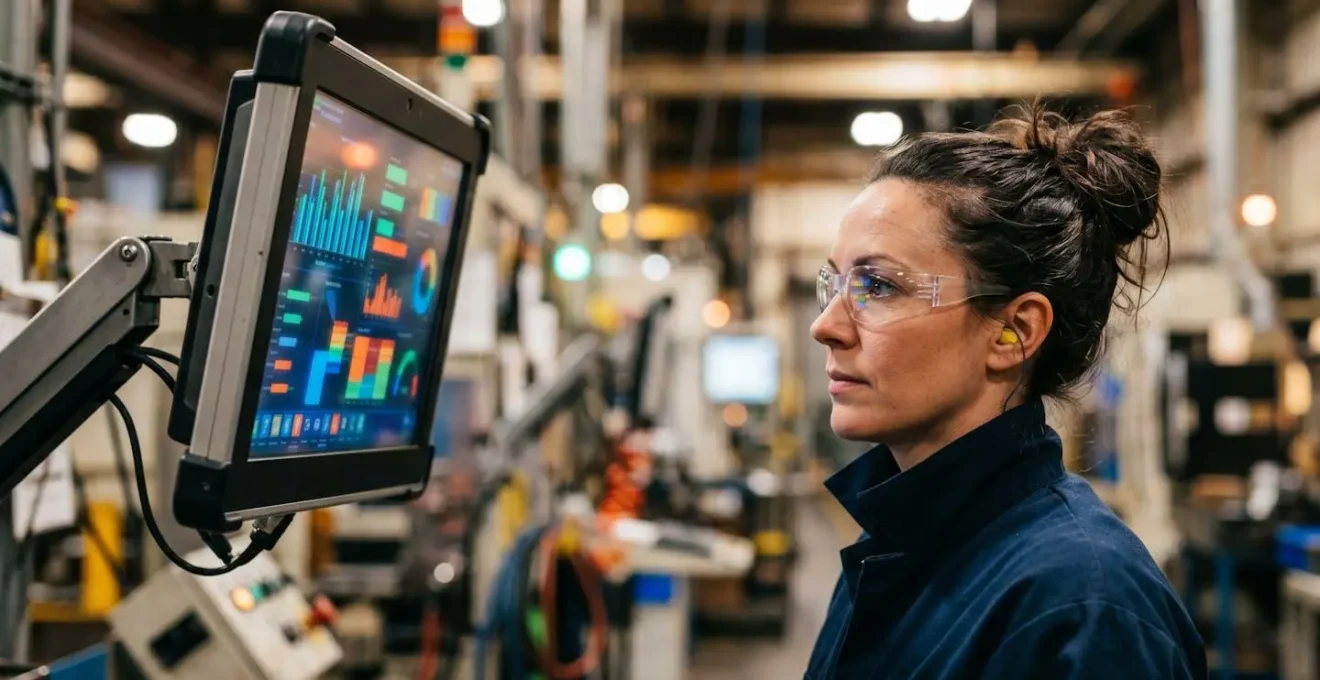
Presenting this information directly to a machine operator or a shift supervisor empowers them to make decisions that have an immediate financial impact. When an operator can see that a certain machine setting is actively eroding the profit margin on the parts they are producing, they are motivated and equipped to make an adjustment. This transforms team members from simple production workers into guardians of profitability.
This level of connectivity allows for better-informed decisions at every level. It closes the loop between action and financial consequence, which is the only sustainable way to combat margin erosion. The dashboard is not just a reporting tool; it is a live, dynamic control system for your factory’s profitability.
When to Switch Shift Handovers From Physical Logs to Tablet-Based Dashboards?
Not every process needs to be digitised on day one. A strategic rollout focuses on areas where data ambiguity causes the most significant financial friction. The shift handover is a classic example. A paper logbook filled with hasty, illegible notes is a recipe for errors, delays, and miscommunication. An incoming operator might misinterpret a note, leading to an incorrect machine setup, or waste the first 30 minutes of their shift trying to decipher what happened previously. These « small » issues accumulate into substantial hidden costs.
The decision to switch from a physical log to a tablet-based digital handover system should not be based on a vague desire to « go digital. » It must be a clear financial decision. The key is to quantify the cost of ambiguity associated with the current paper-based process and compare it against the investment in a digital solution. By treating this as a business case, you can pinpoint the exact financial trigger for making the switch.
A digital handover dashboard, connected to the central ERP, ensures that information is structured, clear, and instantly available. It can pre-populate machine status, list outstanding maintenance tasks, and flag quality alerts from the previous shift. This eliminates guesswork and reduces the « information decay » that plagues paper systems, allowing the incoming shift to be productive from the very first minute. The following checklist provides a financial framework for making this decision.
Action Plan: Justifying Digital Shift Handovers Financially
- Calculate Monthly Cost of Ambiguity: Document instances of production delays, incorrect setups, or quality issues caused by unclear handover notes over 30 days and assign a cost to each.
- Quantify Information Decay Impact: Measure time lost per shift (e.g., 30 minutes) when incoming operators clarify incomplete or illegible information, and multiply by the labour cost.
- Compare Against Solution Cost: Calculate the monthly subscription cost for a digital platform plus the amortised hardware investment (e.g., over 36 months).
- Assess Error Correction Expenses: Track the costs of rework, scrap, or production stoppages that are directly attributable to handover miscommunication.
- Evaluate Threshold Break-Even: The switch is financially justified when the total monthly costs of ambiguity and errors exceed the digital solution’s monthly cost by a target margin (e.g., 20%).
This data-driven approach turns a subjective operational preference into an objective financial decision, ensuring you invest in technology where it will deliver the greatest and most immediate return.
Shortening the Production-to-Invoice Timeline to Retrieve Cash 14 Days Faster
Margin erosion isn’t the only threat to financial health; poor cash flow can be just as damaging. In many manufacturing businesses, the timeline between a product rolling off the assembly line and an invoice being sent to the customer is unnecessarily long. This delay is another symptom of fragmented data. The production team marks a job as « complete » in their system, but the shipping department doesn’t see it for a day. Shipping confirms dispatch, but the finance team has to manually chase paperwork before they can generate an invoice. Each of these manual handoffs introduces a delay, trapping cash in your operational cycle.
A unified ERP system with real-time data integration can radically compress this « production-to-invoice » timeline. By creating automated, event-driven workflows, you can eliminate the manual data-chasing that slows down your cash flow. This is a core part of the architectural blueprint for a financially resilient factory.
Imagine this automated workflow:
- A sensor on the production line signals that the final unit of an order has been completed.
- This event automatically updates the ERP, changing the order status from « In Production » to « Ready for Dispatch. »
- The shipping department receives an instant notification and prepares the shipment. When they scan the package out, the ERP status updates to « Shipped. »
- This « Shipped » event automatically triggers the finance module to generate and send the invoice to the customer, without any human intervention.
Case Study: Automated Invoicing and Cash Flow Acceleration
By implementing a unified ERP with event-driven workflows, manufacturing companies have successfully automated the entire production-to-invoice process. The moment a production run is marked as complete and shipped, the system automatically generates and dispatches the corresponding invoice. This seamless integration eliminates the « data lag » between production, shipping, and finance teams. As a result, organisations have significantly reduced invoice processing time, improved cash flow predictability, and, in many cases, shortened their cash conversion cycle by over 14 days.
By shortening this cycle, you are effectively injecting cash back into your business faster. This improved liquidity can be used to invest in new equipment, negotiate better terms with suppliers, or simply provide a stronger financial buffer. It’s another powerful example of how connecting operational data to financial processes delivers tangible, bottom-line results.
Key Takeaways
- Disconnected data systems (like spreadsheets) are not neutral; they actively hide errors and financial leaks, creating a distorted view of profitability.
- The transition to a unified system is a strategic project, best de-risked through a parallel run approach that avoids production downtime.
- An ERP implementation’s success hinges on fiercely defending a core scope: creating a single source of truth for real-time profitability, not trying to be all things to all people.
Automating Administrative Workflows to Save 20 Hours a Week on Tedious Data Entry
The visible costs of fragmented data, like scrap and downtime, are often the focus. However, an enormous amount of margin is also lost to a less visible culprit: administrative waste. Think of the hours your skilled engineers, production managers, and finance team spend manually re-keying data from one system to another. This is low-value, repetitive work that not only drains morale but also represents a significant and unnecessary labour cost. Business productivity research indicates that employees can lose between 240 to 360 hours annually on such repetitive tasks.
A unified data architecture is the ultimate weapon against this administrative drag. When all your systems—from shop floor sensors to your CRM and accounting software—are integrated into a central ERP, you can automate the flow of information. The same event-driven workflows that accelerate invoicing can also eliminate countless hours of manual data entry. For example, when raw materials are received, a barcode scan can automatically update inventory levels, notify the production planner, and queue the supplier’s invoice for payment in the accounting system.

This automation frees up your most valuable assets—your people—to focus on high-value work: process improvement, quality control, and strategic planning. Instead of chasing data, they can start using it to make better decisions. The advent of AI-powered analytics within modern ERPs further amplifies this benefit. These tools can proactively identify trends, predict maintenance needs, and suggest production optimisations, delivering significant productivity gains.
Ultimately, the blueprint for unifying your data is also a blueprint for creating a leaner, more intelligent, and more profitable organisation. It transforms your factory from a collection of disconnected activities into a single, cohesive system where data flows seamlessly, administrative friction is eliminated, and every decision is informed by real-time financial context. This is the foundation for sustainable growth in a competitive market.
The next logical step is to move from understanding these principles to applying them. Begin by commissioning a formal audit of your current data fragmentation and its estimated monthly cost to build the business case for creating a single source of truth.